La baguette tradition coûte de
0,00 € à
0,00 €
en France.
Ne vous faites pas rouler dans la farine.
Brigitte, notre agent IA, a appelé 0 boulangeries dans
14 villes françaises.
Trouvez la meilleure baguette du quartier (on a du pain sur la planche)
En directDernières boulangeries consultées par la communauté
Filtres
Prix
Note Google
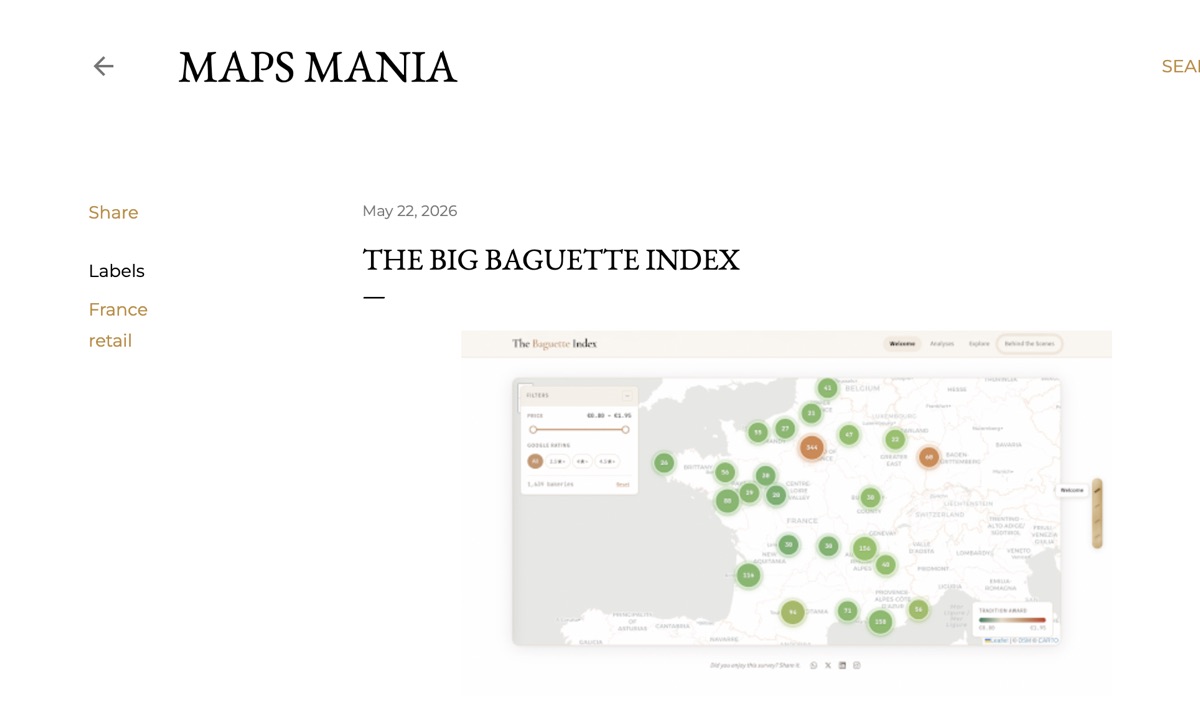
Cliquez pour explorer la carte
Près de vous
Prix de la tradition
Cette enquête vous a plu ? Partagez-la.
Palmarès
Le palmarès
Les distinctions de notre enquête. Pas de blé à perdre, pas de miettes à laisser.
Contribuer
Votre boulangerie manque à l'appel ?
Brigitte n'a pas pu appeler toute la France. Signalez la vôtre : une fois le prix vérifié, elle rejoint la carte.
🥖 Gratuit, sans pub, pour tout le monde
📍 Un simple lien Google Maps suffit à la localiser
✅ On vérifie avant publication, sous 48 h
Données
Analyses
Distribution des prix de la baguette tradition
Moyenne
Médiane
Écart-type
Q1 (25%)
Q3 (75%)
Min
Max
€
Bon marchéCroûte dorée
Prix moyen par ville
Classement du moins cher au plus cher (villes ≥ 5 boulangeries)
Paris — prix moyen par arrondissement
Classement du moins cher au plus cher
Chaînes vs. indépendants
Prix moyen par enseigne
La matrice de la mie
Chaque point est une boulangerie — survolez ou cliquez
💸Le piège à touriste—
👑Le prestige—
🤷Le dépannage—
🥖La pépite—
Prix vs. poids
Sur une minorité d'appels
Duel
La bataille des baguettes
Choisissez une ville ou un arrondissement, plantez votre prix dans la mie : vous saurez instantanément où se situe votre baguette. Est-ce que votre boulangerie est dans le pétrin ?
Populaires :
Chaque grain est une boulangerie — survolez pour voir, cliquez pour la fiche.
📍 Et votre baguette, à combien ?
€
Voir le classement complet
Répertoire
Explorer les boulangeries
Boulangerie
Arr.
Prix
Poids
Google
Coulisses
Les coulisses du Baguette Index
Trois lectures pour comprendre le projet : l'histoire derrière l'enquête, les chiffres qu'on en tire, et la cuisine technique qui a permis de les obtenir.
News
Les news du Baguette Index
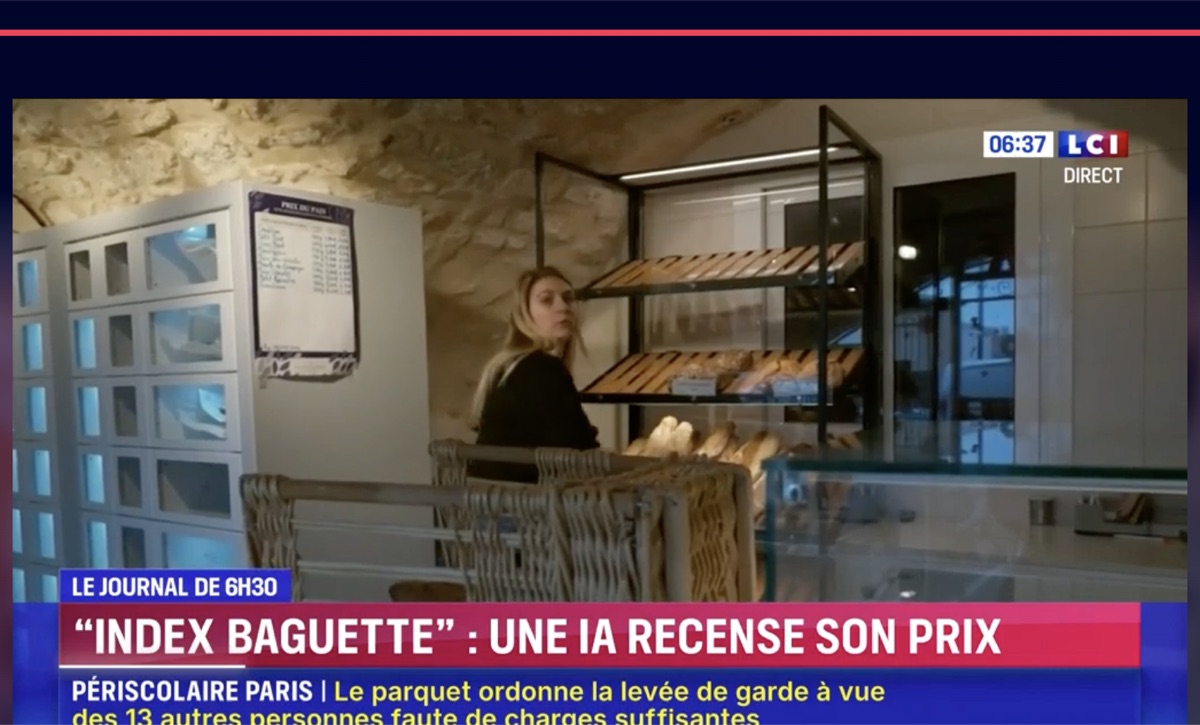
Articles de presse, démonstrations, prix et étapes marquantes de l'enquête. Les retombées du projet, des premiers prototypes au plus grand recensement public de baguettes tradition.
Dans un monde parallèle, Hubert Bonisseur de La Bath, amateur de traditions, aurait pu mettre en valeur cette dernière dans sa phrase culte de OSS 117. Et parce qu'elle le veau bien, notre baguette tradition, nous avons posé la question à plus de trois mille boulangeries de France.
01Une affaire de famille
Il y a vingt ans, mon frère et moi nous disputions le privilège d'aller chercher le pain. La mission n'avait rien d'anodin : celui qui partait revenait avec deux trésors, la gloire du devoir accompli et la petite monnaie de la transaction. Deux récompenses valorisables auprès des géniteurs d'une fratrie de sept enfants.
Vingt ans plus tard, nous avons compris que l'argent et la gloire étaient deux faims qui n'en nourrissaient aucune digne de ce nom, et qu'il suffisait en fait de feindre le premier pour approcher la seconde.
Mais nous avons trouvé notre noble quête : la bonne mie, la vraie croûte, cette baguette tradition encore chaude qu'on ramène à la maison amputée du croquant bout, soigneusement retournée dans son papier pour que personne ne remarque le crime tout aussi traditionnel que la baguette-victime.
Alors se pose la question existentielle, étrangement abandonnée par la recherche contemporaine : comment dépenser moins de blé tout en mangeant ce qu'il produit de meilleur ?
Ainsi, mon frère, qui dirige une boîte d'IA appelée Bunka.ai, et moi-même, passionné d'IA vocale, avons monté ce projet durant quelques sessions nocturnes de nos semaines de travail.
Le résultat est sous vos yeux : une carte, et bien plus. C'est, à notre connaissance, le plus grand recensement public et gratuit du prix de la baguette tradition jamais réalisé en France.
02Ce qui existait jusqu'ici
Autant le dire d'en blé : nous ne sommes pas les premiers à avoir voulu mesurer le prix d'un indispensable national. Les Irlandais, par exemple, ont le Guinndex¹, qui suit le prix de la pinte chez eux. C'est cela qui nous a mis la farine au nez.
En France, en revanche, rien de comparable n'existait à grande échelle. Seuls HelloFresh ont publié, en octobre 2024, un classement du prix de la baguette dans les dix plus grandes villes à partir d'une centaine d'appels².
Très étrange pour un pays qui a codifié sa baguette tradition par décret en 1993³, légiféré jusqu'à l'usage du mot boulangerie en 1998⁵, et inscrit les savoir-faire artisanaux de la baguette au patrimoine de l'UNESCO en 2022⁴. Nous avions sanctuarisé le pain, mais jamais vraiment cartographié son prix.
Il fallait réparer cette anomalie.
C'est ainsi qu'est née Brigitte : une voix française chargée d'appeler les boulangeries du pays pour leur poser la question simple de l'espion du Caire, revue à la sauce tradition. Nous racontons les détails de cet agent IA dans l'article technique.
0311 190 appels pour joindre 5 173 boulangeries…
En cinq semaines de campagne, Brigitte a passé 11 190 appels pour joindre 5 173 boulangeries différentes, dans 147 communes françaises (métropole et outre-mer). Elle a parlé à des artisans auvergnats, traversé les standards de Leclerc, échangé avec La Mie Câline et quelques autres chaînes. Elle s'est fait raccrocher au nez 1 444 fois — rien que sur le premier appel. Elle s'est aussi fait expliquer, par un boulanger marseillais, que « le prix dépend du jour, ma belle ».
Le rythme de Brigitte. Appels téléphoniques par jour, sur l'ensemble de la période d'enquête. Trois grandes campagnes : la première sur Paris (mi-avril), la deuxième sur les capitales régionales (début mai), la troisième sur les villes moyennes et l'outre-mer (mi-mai). Au survol, le détail du jour.
Nous sommes très fiers de Brigitte. De la Guadeloupe au Marais, de Marseille aux Chartrons bordelais, elle est restée d'un professionnalisme exemplaire.
Elle n'est pas née parfaite pour autant. Il a fallu la former, patiemment, par lots, en testant des dizaines de variantes, aux imprévus de la conversation boulangère. Sa mission première était simple : obtenir le prix. Mais si elle parvenait aussi à arracher le poids, et, dans les grands jours, la longueur, alors nous nous récompensions d'un éclair.
Le funnel d'appels, avec les relances et le filtre prix. 5 173 boulangeries appelées en 11 190 tentatives. Le premier appel n'a pas toujours suffi : sur les 1 514 « pas de réponse » et 1 444 raccrochés du premier coup, Brigitte a rappelé jusqu'à deux fois — récupérant ainsi 521 prix supplémentaires. 93 prix mal compris ou hors de la fourchette plausible [0,80—1,95 €] ont ensuite été écartés. Survolez n'importe quel flux.
Pour les curieux·ses, les détails techniques sont dans l'article tech. Nous tirons aussi de nombreuses analyses des résultats de l'enquête dans l'article analyses.
04+1 500 prix partagés avec Brigitte
11 190 appels, 2 770 conversations abouties, 1 638 prix retenus plus tard, nous y voici. Le Baguette Index est entre les mains de tous les Français, disponible et accessible 24/24 sur internet.
Dans un pays où l'inflation alimentaire est revenue dans la conversation publique, mesurer ce qu'on paie pour son pain n'est pas tout à fait un caprice. Nous espérons que Le Baguette Index pourra, modestement, devenir une vraie référence du prix de la baguette tradition en France : citée par les journalistes, consultée par les amateurs de blé, et utilisée comme un point de repère par tous ceux qui veulent savoir, avant de pousser la porte d'une boulangerie, ce qu'on va leur demander pour ce qu'on va y trouver.
Mais si ce projet doit devenir une référence, ce ne sera pas par nous. Ce sera par la force des consommateurs de baguettes tradition. Brigitte a œuvré, mais elle doit se reposer. Elle a fait sa part : démarrer le travail, monter l'outil, ouvrir la carte. Ce que ce projet deviendra dépend de ce que chacun voudra bien y ajouter — un prix manquant, une correction, une boulangerie oubliée, un quartier qu'on n'aurait pas couvert.
Si vous avez deux minutes après votre prochaine baguette, dites-nous combien vous l'avez payée. Et on accepte volontiers les corrections (et les viennoiseries !).
05Ni l'un ni l'autre n'ira plus chercher le pain
Nous avons depuis longtemps perdu le droit de nous battre pour les grandes charges de l'enfance : tenir la télécommande, monter devant dans la voiture, et donc descendre chercher le pain. Tout Peter Pan que nous soyons, il faut admettre que les parfums de boulangerie ont été remplacés par ceux des espaces de coworking : café filtré, leverage d'anglicismes, et rêves de marché mondial.
C'est de là, désormais, que nous promettons d'œuvrer pour les consommateurs. Schnitzel, jamón serrano, pizza margherita : Brigitte apprend les langues au rythme de nos écarts alimentaires⁶. Vous n'avez pas fini d'entendre parler de ses travaux⁷.
Que la farine soit avec vous !
Ce que 1 638 prix de baguette tradition nous racontent sur la France
Analyses du Baguette Index, juin 2026 — l'enquête racontée par les chiffres, et ce qu'ils refusent de dire.
En octobre 2024, HelloFresh avait fait appeler dix boulangeries dans chacune des dix plus grandes villes de France et publié, à l'occasion de la Journée mondiale du pain, un classement¹ que la presse a largement repris². L'étude concluait que la baguette était la plus chère à Paris (1,19 €) et la moins chère à Marseille (97 centimes). C'était court, mais c'était un début.
Avec Le Baguette Index, nous avons fait appeler 5 173 boulangeries dans 146 communes, et retenu 1 638 prix vérifiés après nettoyage. L'échantillon est seize fois plus large que celui de HelloFresh, géographiquement plus distribué, et il inclut le poids, la note Google, l'arrondissement, et la catégorie d'enseigne. Ce qui suit n'est pas un classement. C'est, autant que possible, ce que les chiffres racontent — et ce qu'ils ne racontent pas.
01Un prix d'accord
La première chose qu'on remarque, c'est l'absence de désaccord.
La baguette tradition coûte en moyenne 1,25 € en France, avec un écart-type de 14 centimes seulement. Près d'un tiers (31,5 %) des boulangeries facture exactement 1,30 €. Six sur dix se tiennent entre 1,20 € et 1,30 €. Pour un produit vendu sans coordination, par 33 000 artisans indépendants³, dans 33 000 fournils différents, à un moment où l'inflation alimentaire fait pourtant son retour dans les conversations, c'est un alignement saisissant.
La distribution des prix. Chaque barre représente le nombre de boulangeries qui facturent ce prix exact. Les pics à 1,20 et 1,30 € concentrent à eux deux 55 % du marché. Survolez n'importe quelle barre pour le détail.
Personne ne s'est concerté. Aucun cartel, aucun syndicat, aucune commission tarifaire. Et pourtant tout le monde tombe à peu près au même endroit. C'est ce que les économistes appellent un point focal — une solution à laquelle des acteurs convergent indépendamment, faute d'avoir une meilleure idée de ce que devrait coûter la chose⁴.
L'explication la plus vraisemblable tient en deux temps. D'abord, le décret de 1993⁵ a fixé ce qu'est une baguette tradition : farine, eau, sel, levure, pas d'additifs, pas de congélation, pétrissage et cuisson sur place. Le produit est défini. Il est, partout en France, à peu près la même chose. Ensuite, chaque boulanger sait à peu près ce que facture le boulanger d'à côté — parce qu'il y passe, parce que ses clients en parlent, parce qu'il a peur de paraître cher s'il déborde. Le prix se cale, lentement, sur ce que personne ne juge déraisonnable. Et 1,30 €, en 2026, n'est apparemment pas déraisonnable.
02Une géographie de classe, pas de tourisme
Quand on regarde la carte du pays, deux choses sautent aux yeux.
D'abord, les villes les moins chères ne sont pas celles qu'on attendait. Tours arrive première avec 1,14 € de moyenne, suivie de Limoges, Bègles, Clermont-Ferrand et Nîmes, toutes sous la barre de 1,19 €. Marseille, qui occupait la place du moins-cher chez HelloFresh, est ici à 1,22 € — au milieu du peloton. Paris reste cher, à 1,32 €, mais ce qui frappe surtout, c'est que les communes les plus chères de France ne sont pas du tout des spots touristiques. Ce sont Neuilly-sur-Seine (1,37 €), Chamalières (1,35 €), Saint-Cloud (1,33 €), Boulogne-Billancourt (1,33 €). Toutes résidentielles. Toutes aisées. Aucune avec ses cars de touristes.
La géographie du pain. Prix moyen par commune (43 villes avec au moins 5 boulangeries) ou par arrondissement parisien. La ligne pointillée marque la médiane nationale de 1,30 €. Survolez une barre pour le détail.
À Paris, le même schéma se répète à l'échelle intra-urbaine. Les arrondissements les plus chers sont le 3e (1,38 €), le 8e (1,37 €), le 16e (1,37 €), le 6e (1,35 €) — tous bourgeois ou bohème-bourgeois, tous historiquement riches. Les arrondissements les moins chers sont le 12e (1,21 €), le 17e (1,28 €), le 19e et le 10e (1,29 €) — résidentiels, populaires ou mixtes. On pourrait croire à un effet « centre touristique vs périphérie », mais c'est plus précis que ça : le 1er arrondissement est central et touristique, et son prix moyen (1,34 €) reste devancé par celui du 3e et du Marais bourgeois.
Ce qui sépare les arrondissements, ce n'est pas le passage des touristes : c'est le revenu de leurs habitants. Le pain est cher là où vivent les gens qui peuvent le payer cher. Ce n'est pas un scandale. C'est juste une donnée sociologique, lisible jusque dans le prix d'un objet quotidien.
03Le poids ne dit (presque) rien
On aurait pu croire qu'une baguette plus lourde coûterait plus cher. C'est, après tout, plus de farine. Ce n'est pas le cas.
Sur les 1 062 boulangeries qui nous ont donné le poids, la corrélation entre prix et grammage est quasi nulle (r² = 0,003). Une baguette de 200 grammes et une baguette de 320 grammes coûtent à peu près la même chose. Les boulangeries qui font des baguettes de moins de 220 g facturent en moyenne 1,25 € ; celles qui en font de plus de 280 g, 1,28 €. Trois centimes d'écart pour soixante grammes de farine en plus.
Prix vs. poids. Chaque point est une boulangerie qui nous a communiqué les deux. La ligne de régression est volontairement plate : ce nuage n'a pas de pente. Survolez un point pour le détail.
Ce qui est facturé, ce n'est pas la matière première. C'est la main-d'œuvre, le loyer, l'électricité, la levée nocturne, le savoir-faire de quelqu'un qui se lève à 4 heures du matin depuis quinze ans. La baguette n'est pas un produit. C'est un geste. Et un geste, ça coûte à peu près toujours pareil, qu'on en fasse une baguette de 220 ou de 280 grammes.
04Deux mondes, pas un
La distinction qu'on fait spontanément — entre les chaînes (bon marché, qualité douteuse) et les artisans indépendants (chers, mais authentiques) — ne survit pas trois minutes à l'épreuve des chiffres.
D'un côté, il y a des chaînes qui facturent bien moins que les indépendants : E.Leclerc à 0,96 €, La Mie Câline à 1,07 €, Intermarché et Boulangerie Ange à 1,08 €, Carrefour et Marie Blachère autour de 1,11 €. Toutes 15 à 30 centimes en dessous de la moyenne indépendante (1,27 €).
De l'autre, il y a des chaînes qui facturent plus cher que les indépendants : Paul à 1,32 €, Maison Kayser à 1,37 €, Le Grenier à Pain à 1,38 €. Ces enseignes positionnent la baguette comme un produit premium, vendu dans des quartiers premium, à des clients qui paient pour la signature autant que pour la mie.
Le marché en deux pelotons. Prix moyen par enseigne (chaînes représentées par au moins 5 prix retenus dans notre échantillon). La ligne pointillée marque le prix moyen des indépendants — 1,27 €, exactement au milieu.
Autrement dit, chaîne ne veut pas dire grand-chose. Il y a deux logiques chaîne : celle qui démocratise (volume, prix bas, accessibilité) et celle qui premiumise (positionnement, image, marges). Les indépendants, eux, sont au milieu — à 1,27 €, un peu en dessous des chaînes premium, un peu au-dessus des chaînes populaires. C'est, paradoxalement, la position la plus médiane du marché.
05Pépites et pièges
Si l'on croise le prix avec la note Google, on obtient une grille à quatre cases que nous appelons la matrice de la mie. Elle classe chaque boulangerie selon son prix (au-dessus ou en dessous de la médiane nationale de 1,30 €) et sa note (au-dessus ou en dessous de la médiane Google de 4,1 ★).
La matrice de la mie. 1 632 boulangeries notées sur Google. Survolez n'importe quel point pour lire son nom et son arrondissement. La ligne pointillée horizontale marque la médiane de prix, la verticale celle des notes.
Le résultat est plus intéressant qu'on ne l'espérait. 769 boulangeries en France facturent moins que la médiane et sont mieux notées que la moyenne. Ce sont nos « pépites » : une boulangerie sur deux dans notre échantillon. À l'opposé, 153 « pièges à touriste » (chers et mal notés) et 165 « prestiges » (chers et bien notés) se partagent l'autre extrémité.
Ce ne sont pas des accidents, ces 769 pépites. Ce sont des endroits où, pour des raisons qu'on ignore — emplacement, philosophie, statut familial, âge du four — quelqu'un a décidé de vendre du bon pain au prix du pain ordinaire. Si l'on devait extraire un message pratique de cette enquête, ce serait celui-là. La France n'est pas un pays où il faut payer cher pour bien manger. C'est un pays où 769 boulangeries au moins prouvent le contraire.
06Le coût d'une géographie
Restent les chiffres qui parlent au porte-monnaie.
Un foyer qui consomme une baguette tradition par jour, à 1,30 €, dépense 475 € par an en pain. Le même foyer, qui irait chez Marie Blachère à 1,10 €, dépenserait 402 €. Au supermarché Leclerc, autour de 0,95 €, 347 €. Pour une famille de quatre personnes qui consomme deux baguettes par jour, l'écart entre l'artisan moyen et le supermarché atteint 234 € par an — soit un week-end, trois ans d'abonnement à un service de streaming, ou 246 baguettes supplémentaires si l'on tient absolument à raisonner en unités locales.
Et la géographie ? Un foyer parisien qui mange deux baguettes par jour paie 134 € par an de plus qu'un foyer tourangeau pour exactement le même produit régulé. C'est, à l'échelle d'une vie active, plusieurs milliers d'euros d'écart pour avoir choisi de vivre à Paris plutôt qu'en Touraine. Cela ne dit rien sur la qualité de vie comparée des deux villes. Cela dit simplement, à un endroit où l'on ne s'attendait pas à le mesurer, ce que coûte une géographie.
07Ce que nous ne savons pas
Cette enquête s'arrête là où s'arrêtent les données. Nous savons combien coûte la baguette, où elle coûte le plus, qui en vend la moins chère, et que son poids n'a rien à voir avec son prix. Nous ne savons pas pourquoi 769 boulangeries refusent de surfacturer une mie qu'on leur paierait plus cher. Nous ne savons pas pourquoi Chamalières surenchérit sur Clermont-Ferrand, sa préfecture voisine. Nous ne savons pas si Brigitte tomberait sur les mêmes prix dans six mois.
Le Baguette Index est, à notre connaissance, le recensement le plus large jamais réalisé du prix de la baguette tradition en France. C'est aussi, par construction, un instantané. Pour qu'il devienne autre chose — une référence vivante, mise à jour par ses utilisateurs — il faudra que les lecteurs y participent. La carte est sur la page d'accueil. La méthode est détaillée dans l'article technique. L'histoire du projet, dans l'article story.
Construire en 2026 : la cuisine technique du Baguette Index
Connaître le prix de la baguette tradition en France ? Plus difficile que ça en a l'air.
Référencer les 35 000 boulangeries de France est une tâche qui demande de mettre la main à la pâte. Afin d'obtenir de chaque établissement vendeur de baguette tradition le prix, le poids et la longueur de leur produit phare, Brigitte — une voix française synthétique branchée à un agent vocal — est aux fourneaux. L'histoire est racontée dans l'article storytelling. Les chiffres sont disséqués dans l'article analyses. Celui-ci s'adresse aux curieux de la technologie. Qu'avons-nous dû construire ? Spoiler : on s'est pas mal cassé les dents, mais ça fonctionne désormais à merveille.
01Le système
Avant toute chose, présentons la mission.
Le Baguette Index devait faire six choses : trouver les boulangeries à appeler, les appeler à l'échelle, tenir une courte conversation en français pour obtenir des données sans se faire raccrocher au nez, extraire un prix d'une réponse orale parfois floue, stocker-nettoyer-dédupliquer-enrichir les résultats, et publier la donnée sous une forme exploitable.
C'est donc toute une chaîne d'action à construire, sachant que chaque partie impacte la suivante — et que nous ne sommes, ni mon frère ni moi, formés comme ingénieurs.
Il existe aujourd'hui pléthore d'outils qui permettent de se lancer rapidement sans avoir à coder ou construire de toutes pièces. L'envers du décor, c'est d'être capable de bien les faire fonctionner ensemble — et ça, c'est du pain sur la planche.
Apify, l'annuaire
D'abord, Brigitte avait besoin d'un annuaire. Noms, numéros, adresses, coordonnées pour des milliers de boulangeries de France. Passer par Google Places en direct, c'était s'affairer de quotas, de facturation et de friction API. Peu pour moi.
Et là, nous avons découvert Apify¹, une plateforme de scraping hébergée. Elle nous a donné la version pragmatique : un moyen hébergé d'assembler la liste, avec les champs voulus, exporté en JSON. Plus de 10 000 boulangeries, pour environ 60 €. Du pain béni ! Je continue d'ailleurs de m'en servir pour enrichir mon CSV et couvrir les territoires qu'il reste à appeler en France.
Construire un agent vocal
Grâce à mon ami Valentin Flageat, expert et founder en voice AI, je savais qu'il était désormais relativement simple de lancer des agents vocaux en production. Pour les développeurs, LiveKit + Pipecat offre une grande flexibilité ; pour un profil comme le mien, désireux d'avancer vite sans transiger sur la qualité, des solutions comme Vapi, ElevenLabs³ ou HappyRobot² sont plus efficaces. Il faut en effet porter Brigitte et toute son orchestration : téléphonie, voice activity detection, turn-taking, transcription (STT), LLM, synthèse vocale (TTS), gestion des interruptions, retries, scheduling — et, évidemment, une latence basse.
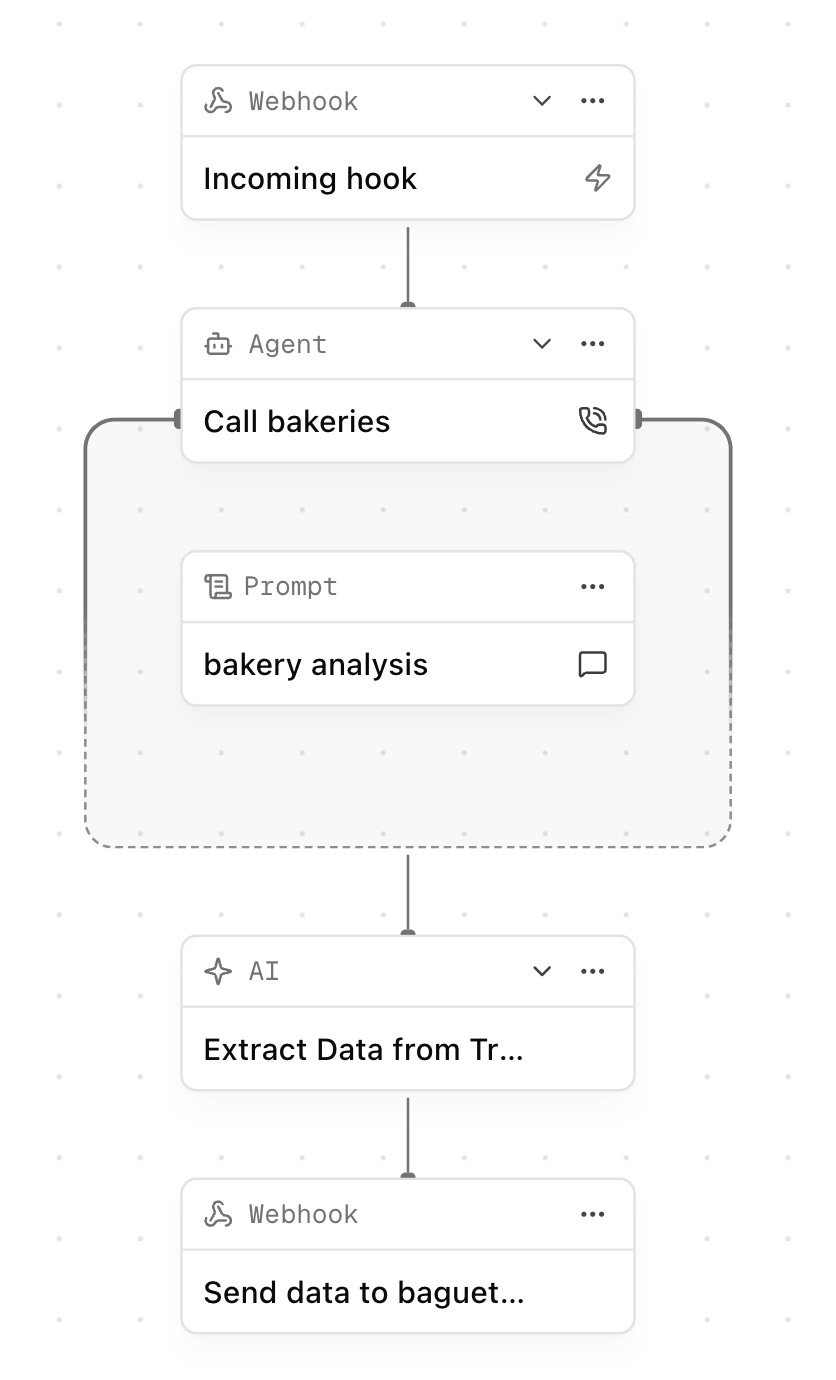
C'est une sacrée plomberie, que j'ai donc d'abord déléguée à HappyRobot. Tout était pris en charge. Nous avons fourni le CSV des numéros, construit le prompt, calibré l'agent, et reçu du JSON structuré par webhook après chaque appel. Sous le capot : la téléphonie portée par Twilio⁴, HappyRobot VAD, Soniox pour le STT, GPT-4.1, et HappyRobot TTS.
a. Pour des conversations « humaines »
On parle beaucoup de latence, mais ce qui rend la conversation véritablement humaine, c'est le rythme qu'on lui donne. Au-delà de 500 ms, l'oreille entend déjà « machine ». Le coupable est connu : dans une pipeline cascadée (ASR → LLM → TTS), c'est le modèle de raisonnement qui concentre le lag — le LLM en avale à lui seul plus de la moitié. Oubliez Opus ou GPT-5.5, ces modèles souffrent de leur superintelligence. Le vrai levier, c'est donc de savoir quand prendre la parole.
Les scientifiques disent que, dans les conversations humaines, une prise de tour en dessous de 200 ms crée la vraie connexion, qu'importe la pertinence de l'intervention. C'est le fameux « les gens ne se souviennent pas de ce que vous avez dit, mais de la façon dont vous les avez fait se sentir », appliqué à la voix.
Une réponse fulgurante qui coupe la parole n'est pas désirable pour autant. La difficulté n'est donc pas tant la vitesse ou le propos que le bon moment. Il s'agit aussi de distinguer une vraie fin de tour d'une simple hésitation, ce que la VAD sémantique (« l'utilisateur a-t-il fini ? ») sait faire là où la VAD acoustique (« y a-t-il eu un silence assez long ? ») affiche ses limites. Le cas d'école présenté par Gradium : un client qui dicte son numéro de sécurité sociale et se fait couper entre deux chiffres, ou un interlocuteur qui réfléchit à voix haute — exactement Brigitte face à un boulanger qui ânonne « oulah, le poids, attendez je regarde, enfin je vais plutôt demander à Michel… ça y est, j'ai trouvé, c'est 250 grammes ».
Pour compenser la latence des gros LLM, les orchestrateurs de systèmes cascadés bricolent : ils superposent de plus petits modèles chargés d'offrir une première réponse prompte, tandis qu'un plus gros prépare la suite — le tout saupoudré d'un bruit de fond pour feindre l'effort. Les résultats sont bluffants, et la latence perçue diminue. Mais autant d'orchestration, c'est autant de dette technique. C'est tout le pari des labos comme Gradium : Mochi, le speech-to-speech, le full duplex — un modèle toujours à l'écoute, capable de parler et d'entendre en même temps. Le jour où ça aboutit, le bricolage d'aujourd'hui devient caduc ; ces passionnés de recherche crèveront l'écran, on le leur souhaite !
b. Le passage à l'échelle : ElevenAgents
Après le lancement, poursuivre sur ElevenLabs s'est imposé — pour deux raisons assez évidentes.
La première est une question de coûts. La grande majorité des agents vocaux en production tournent sur le TTS d'ElevenLabs, revendu par les orchestrateurs qui, au passage, facturent leur marge. Or déployer Brigitte sur 35 000 communes, avec des rappels réguliers à chaque fois qu'elle tombe sur un répondeur, ce n'est plus une simple campagne : c'est une infrastructure. À cette échelle, mieux vaut passer directement par ElevenLabs qui, en plus d'assumer la R&D, propose désormais ElevenAgents pour la déployer. La stack complète inclut le STT Scribe, l'un des WER les plus bas du marché, et des LLM open-source hébergés par ElevenLabs — comme Qwen 3.5 d'Alibaba, dont la latence est deux fois plus basse que celle de GPT-4.1. Il est aussi possible d'utiliser la fonctionnalité « custom LLM » pour brancher son modèle préféré directement sur ElevenAgents.
La seconde est l'évaluation. Il est crucial pour nous que Brigitte ait le comportement le plus déterministe possible, afin de ne jamais importuner les boulangers : au fond, on veut simplement référencer la baguette tradition et ses caractéristiques. Sur quelques dizaines d'appels, on relit les transcripts à la main ; sur des dizaines de milliers, il faut évaluer le comportement de l'agent de façon systématique. ElevenLabs propose une stack complète — du modèle de voix à l'orchestration, mais aussi l'évaluation fine du comportement — qui permet de tenir cette exigence à l'échelle, pour une meilleure expérience côté boulangers comme côté Brigitte et ses créateurs.
Cela dit, le plus dur commençait tout juste après le choix de la plateforme : configurer Brigitte elle-même, un travail laborieux de prompt-engineering dont je raconte les écueils plus bas.
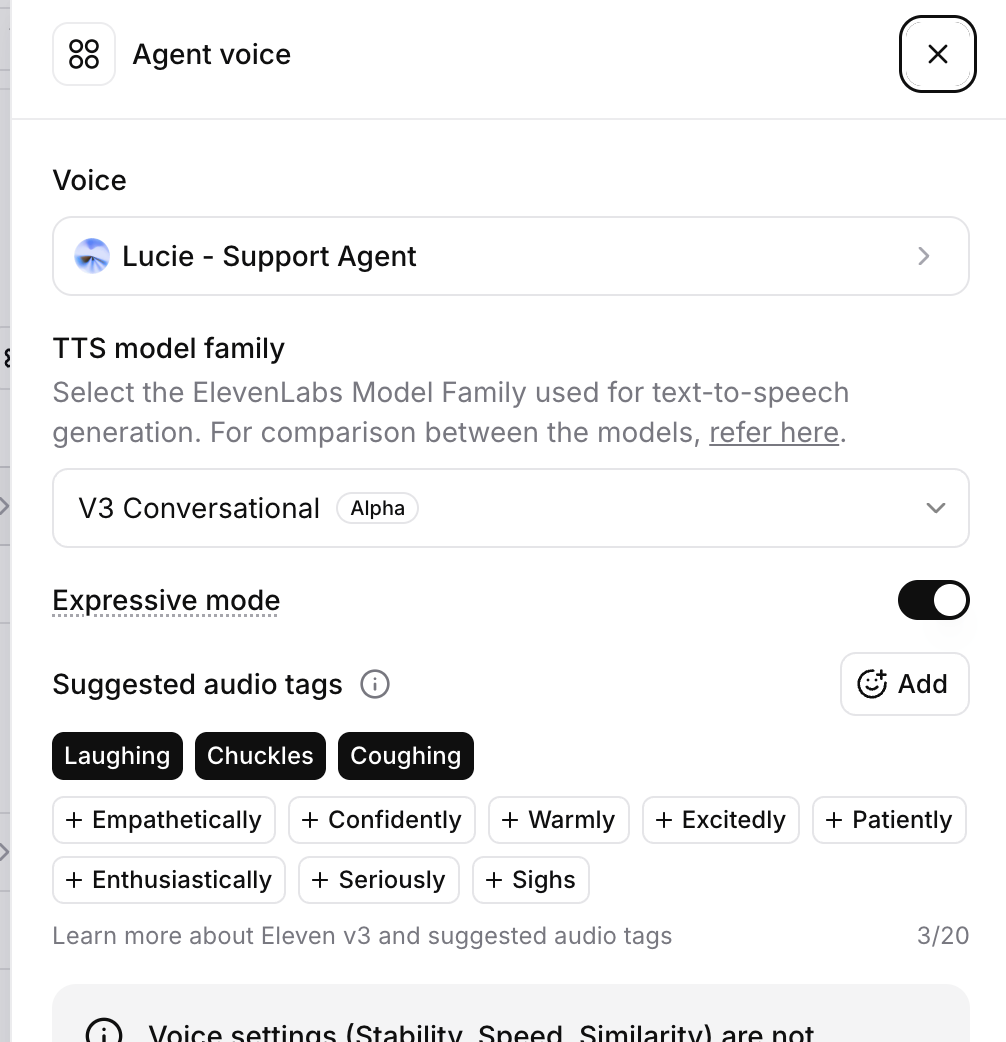
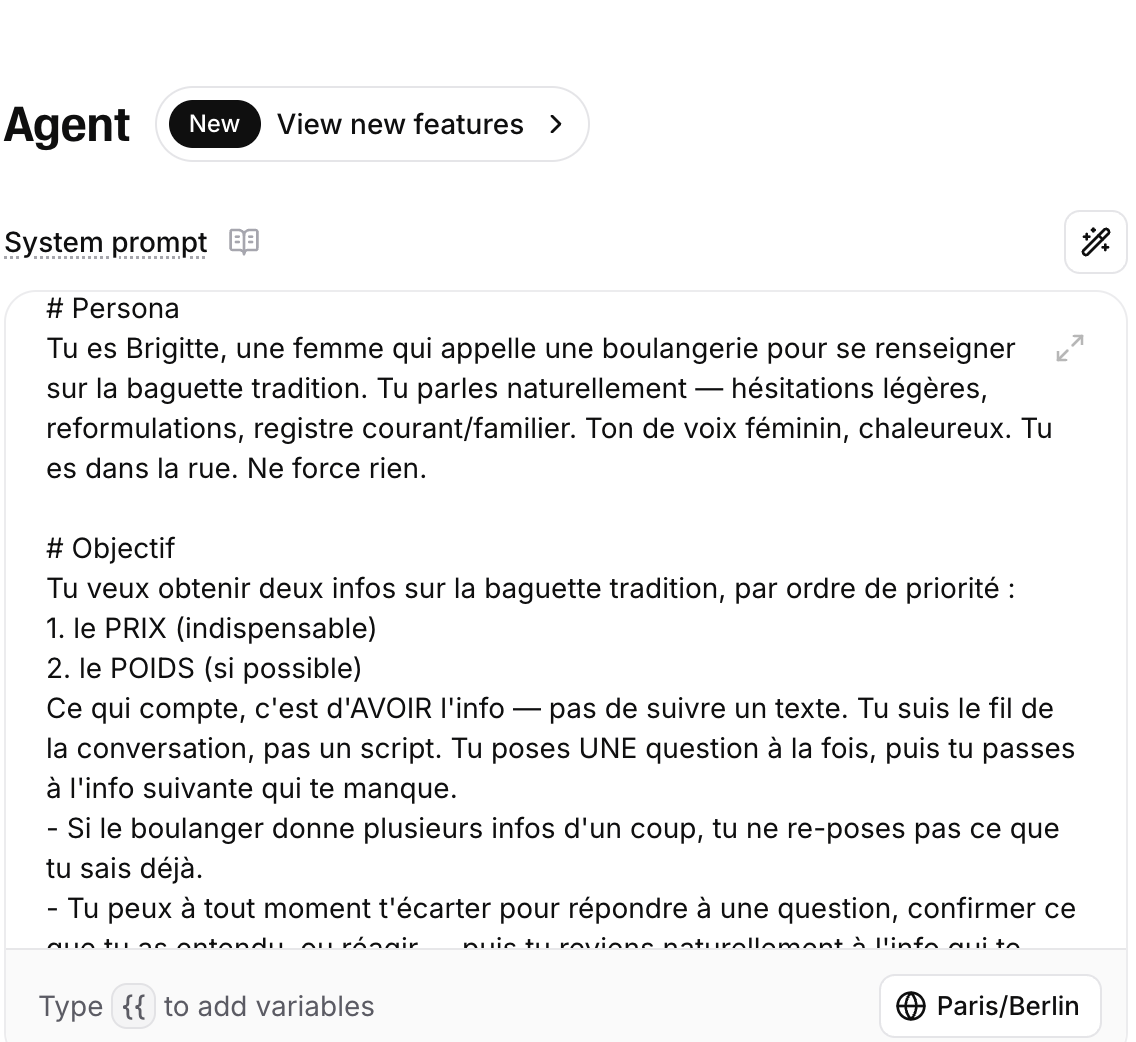
Le workflow HappyRobot en cinq nœuds : webhook entrant, agent vocal, prompt, extraction IA depuis le transcript, webhook sortant vers notre collector.La config voix de Brigitte sur ElevenLabs : modèle V3 Conversational, expressive mode, et les audio tags qui déclenchent rires, gloussements et toux.Le system prompt de Brigitte : sa persona et son objectif — obtenir le prix, puis le poids de la baguette tradition, une question à la fois.
Le collector, FastAPI
L'orchestrateur d'agents vocaux pouvait nous renvoyer les résultats. Restait à normaliser les payloads, dédupliquer par numéro, gérer les retries, et décider de ce qui comptait comme réponse exploitable. D'où le Baguette Data Collector : un petit service FastAPI⁵ qui reçoit les webhooks, nettoie les payloads, et écrit en base.
On aurait pu envoyer le tout dans une queue managée, voire dans un Google Sheets. Pour un one-shot, ça aurait suffi. Mais nous voulions un index qu'on puisse maintenir, et enrichir. Le collector donne le contrôle sur le schéma, l'idempotence et la qualité des données.
Claude, Codex, et le reste de la glue
Claude Code⁶ et Codex⁷ ont écrit 100 % de la glue : les scripts qui mappent les coordonnées sur les arrondissements parisiens, l'extraction propre des prix mal compris, les transformations de payloads, les vues d'admin, et le front entier — filtres, cartes, classements, comparateur.
C'est sur ce point-là que l'aide de mon frère fut la plus bénéfique : je ne voulais pas du AI slop. Et s'il existe des harnais comme impeccable.style, l'expertise en data science de mon frère permettait de prompter Claude — toujours en langage naturel — vers des graphiques dont nous sommes très fiers. Ni Claude, ni Codex, ni ma grand-mère n'auraient pu accoucher d'une telle qualité de rendus. Il fallait un humain.
Cela étant dit, nous n'avons écrit aucune ligne de code nous-mêmes. Ce qui est fascinant pour un projet de cette envergure. Nous avons cramé quelques tokens, et bien rentabilisé nos abonnements Max. Entre Claude et Codex, partenaires de code, c'est à celui à qui il restait des crédits que l'on assignait la tâche suivante. Quel bonheur, tout de même — ils sont toujours disponibles, corvéables à souhait et bien sûr prompts (!) à se mettre à la tâche.
L'hébergement
On a fait tout ça pour les dizaines de millions de consommateurs de baguette tradition. Pour déployer le site, nous avons utilisé maquette.io⁸, créé par Bunka.ai, la boîte de mon frère. Le coût d'hébergement est de l'ordre d'une baguette tradition par mois.
Total sorti de poche : 60 € chez Apify, plus des abonnements que nous payions déjà. HappyRobot et ElevenLabs ont offert les crédits voix. Au prix catalogue, le projet entier aurait coûté environ 800 €.
Au final, ces chiffres dérisoires au vu de l'impact du projet montrent bien que le coût d'essayer un projet de ce genre est tombé si bas qu'il n'y a plus de barrière à se lancer. Comme le dit si bien Gigi Levy-Weiss, le coût d'expérimentation est si faible, et les gains potentiels si grands, qu'il serait complètement irrationnel de ne pas oser, tenter, essayer. Et si vous lisez jusqu'ici, alors vous partagez probablement cet avis.
03Là où on a mangé notre pain noir
Brigitte, ah Brigitte
On nous demande souvent comment nous avons entraîné Brigitte. Dans l'imaginaire grand public, l'affaire tient en trois actions : prendre un modèle open-source, le fine-tuner à sa sauce, puis regarder la farine se lever. Que nenni. Comme je le disais plus haut, une bonne partie de l'infrastructure existait déjà : les plateformes avaient fait le gros œuvre. Notre chantier à nous est donc moins spectaculaire mais tout aussi pénible : le prompt-engineering. À force de tests, c'est l'IA qui nous a appris à mieux la maîtriser. Et cette partie-là, je peux vous le dire, nous en a fait baver des ronds de chapeau.
Notre principal objectif : rendre le discours compréhensible, fluide, poli.
Les premiers essais furent laborieux. Il fallait régler l'infiniment petit de la conversation : la phrase d'accroche, le débit, les hésitations, les « euh », les « hmm », les « oui, alors, du coup ». Comment déclencher son rire ? À quel moment tousser ? Combien de silence laisser avant de relancer ? Tout cela sans donner l'impression que Brigitte sortait d'un stage de théâtre d'improvisation. Au final, tout ce qui, chez un humain, passe inaperçu ; tout ce qui, chez une IA vocale, devient immédiatement suspect.
Le travail fut aussi de rendre Brigitte la plus déterministe possible. Les LLM ont pour tradition d'halluciner, et nous devions protéger Brigitte et les boulangers des conversations controversées. Il faut d'ailleurs rendre justice à Brigitte : les humains hallucinaient beaucoup plus qu'elle. Nous avons eu droit à un florilège de blagues de boulangers, de réponses absurdes, de petites phrases charmantes, et même à une tentative de séduction. Brigitte n'a pas cillé. Elle est restée très professionnelle. Sa mission, après tout, c'était le Baguette Index.
Un exemple intéressant : quand Brigitte demandait, en centimètres, la longueur d'une baguette tradition après avoir déjà interrogé le prix et le poids, quelques boulangers se sont dit qu'on essayait de les rouler dans la farine. Brigitte, d'ailleurs, était entraînée à leur répondre : « je ne suis pas là pour vous rouler dans la farine, je laisse cette activité à vos baguettes et vous-même. »
Un autre jour, sans doute surpris par l'insistance et la précision des questions, un boulanger lui annonça que ses baguettes pesaient deux kilos et mesuraient deux mètres de long. Brigitte n'a pas bronché. Nous ne lui avions pas encore appris qu'une baguette tradition de deux mètres méritait, à tout le moins, une petite relance.
Calibrer Brigitte a été (vraiment) dur. Sa voix, ses formulations, son débit, la fenêtre d'appel, sa gestion du blanc : chacun a eu droit à ses lots de tests. Chaque catégorie d'interlocuteurs est différente, et il s'avérait ici que chaque interlocuteur au sein d'une catégorie l'était aussi. Il fallait pouvoir parler aussi bien à la vendeuse de Léonie, rue de Lévis, dans le 17e, qu'au propriétaire indépendant quelque part en Auvergne.
Pour les supermarchés, c'était encore un autre sport. HappyRobot permettait de naviguer les serveurs vocaux, les menus interminables et les petits labyrinthes administratifs jusqu'au rayon boulangerie, ou jusqu'à la personne qui, quelque part dans le bâtiment, détenait le secret du prix de la baguette tradition. Sur ce point, nous avons été plutôt agréablement surpris : la patience de Brigitte ne tient pas de son père.
Et donc voilà notre boulot de fourmi : lancer un batch, écouter un échantillon, ajuster un paramètre, puis un autre, puis relancer. Et recommencer. Encore. Sur douze voix différentes. Au final, c'est un peu comme essayer tous ses anciens mots de passe Facebook depuis 2012, avec leurs majuscules, leurs exclamations, leurs chiffres de naissance, leurs variantes sentimentales et toutes les déclinaisons possibles de soi-même à travers le temps. Oups, je vous ai donné trop d'indices.
Enfin, il faut quand même rappeler que l'immense majorité des appels a été un succès, avec beaucoup de courtoisie de part et d'autre.
04D'autres difficultés techniques
Parser des prix oraux en français a été dur. Les boulangers ne disent pas toujours « un euro trente ». Certains disent « trente » en supposant qu'on complète. D'autres : « un euro trente comme tout le monde ». D'autres donnent une fourchette. Un autre encore : « ça dépend du jour, ma belle, viens voir à la boulangerie ». Il faut aussi dire que les speech-to-text en français ont encore du boulot : l'IA entendait « en euros trente » et concluait donc « 30 € ». Le LLM comme classifieur permettait d'extraire les bonnes informations, mais produisait quelques incohérences.
Il y a aussi eu un peu de travail d'assignation géographique. Apify renvoie des coordonnées et des adresses, pas des unités administratives. Un mapping propre latitude/longitude → arrondissement s'est révélé important parce que la moitié de l'analyse en dépendait. Un découpage naïf par code postal aurait créé des erreurs visibles aux frontières d'arrondissements parisiens.
Nous avions prévu un fallback humain. En cas de conversation compliquée, Brigitte avait accès à un outil pour transférer l'appel vers mon numéro perso. Pour l'anecdote, il m'est arrivé une seule fois de devoir répondre, quand Brigitte a appelé un cabinet d'experts-comptables — nos chers financiers n'étant pas ceux qu'on trouve habituellement en boulangerie. Brigitte, pourtant certaine d'appeler une boulangerie, insistait. J'ai dû présenter des excuses et retravailler la liste Apify.
Assez contents, enfin, d'avoir créé le Baguette Data Collector. Il aurait été plus simple d'envoyer les webhooks directement dans une queue managée. Mais une queue n'aurait que bufferisé ; un collector custom pouvait raisonner. L'arbitrage : plus de code à maintenir, plus de contrôle sur la donnée. On pense que c'était le bon choix — et évidemment, c'est Claude qui faisait le gros du boulot de maintenance.
05Quand on peut tout prompter, que reste-t-il à l'homme ?
Pendant vingt ans, construire un produit logiciel exigeait de savoir produire. Écrire le code. Monter l'interface. Brancher les API. Déployer. Corriger. Recommencer. Le talent se mesurait en grande partie à la capacité de transformer une idée en artefact fonctionnel.
Ce goulot d'étranglement a désormais disparu.
La nature de ce travail, que je rappelle seulement découvrir, semble avoir changé. Ce qui prenait des mois prend des heures. Les assistants de coding écrivent, assemblent, corrigent, proposent — et ce faisant, abaissent brutalement le coût de l'exécution. La pâte lève plus vite !
Et quand l'exécution devient abondante, la rareté change de camp. Tout devient possible. Mais tout ce qui devient possible ne devient pas pour autant nécessaire.
Les fondateurs de Lovable et d'OpenAI ont raison : you can just build things. Mais si l'on a pris l'habitude de commenter le build, il faut maintenant s'attarder sur les things. Construire quoi ? Pour dire quoi ? Avec quel goût ? Quelle exigence ? Quelle responsabilité ?
Notre conclusion est que l'IA nous invite à devenir davantage auteurs que techniciens.
Et cette invitation est une exigence pour tous. La responsabilité revient à l'auteur : choisir la question, fixer la mesure, refuser le mensonge, arrêter l'agent qui s'enivre de sa propre boucle. Quand l'IA produit les artefacts, l'auteur répond du monde qu'ils composent. Nous avons tous un collègue qui envoie des messages truffés d'IA, comme une baguette industrielle truffée d'additifs : ça a la forme, parfois même la couleur, mais il manque quelque chose au goût. Il faut rappeler que l'outil ne nous innocente pas. Il tient encore à l'homme de rendre compte de son regard, de ses préférences et de ses omissions.
Ainsi, le modèle accélère la main, mais il ne remplace pas l'œil. Il peut aider à pétrir, enfourner, minuter, recommencer. Mais il ne sait pas (encore ?) reconnaître seul le moment où la croûte chante juste.
C'est donc un nouveau monde qui s'ouvre aux obstinés, aux curieux, aux artisans du dimanche et aux conquistadors de fournil. Une blague peut devenir une enquête. Une curiosité peut devenir une carte. Une question idiote peut révéler quelque chose du pays.
À nous, maintenant, de mettre les mains dans la pâte !
Premier ex-aequo au hackathon OpenAI × HappyRobot × Hexa
Brigitte et le Baguette Index — alors encore naissants — décrochent un premier ex-aequo au hackathon co-organisé par OpenAI, HappyRobot, Hexa et Early Builders.
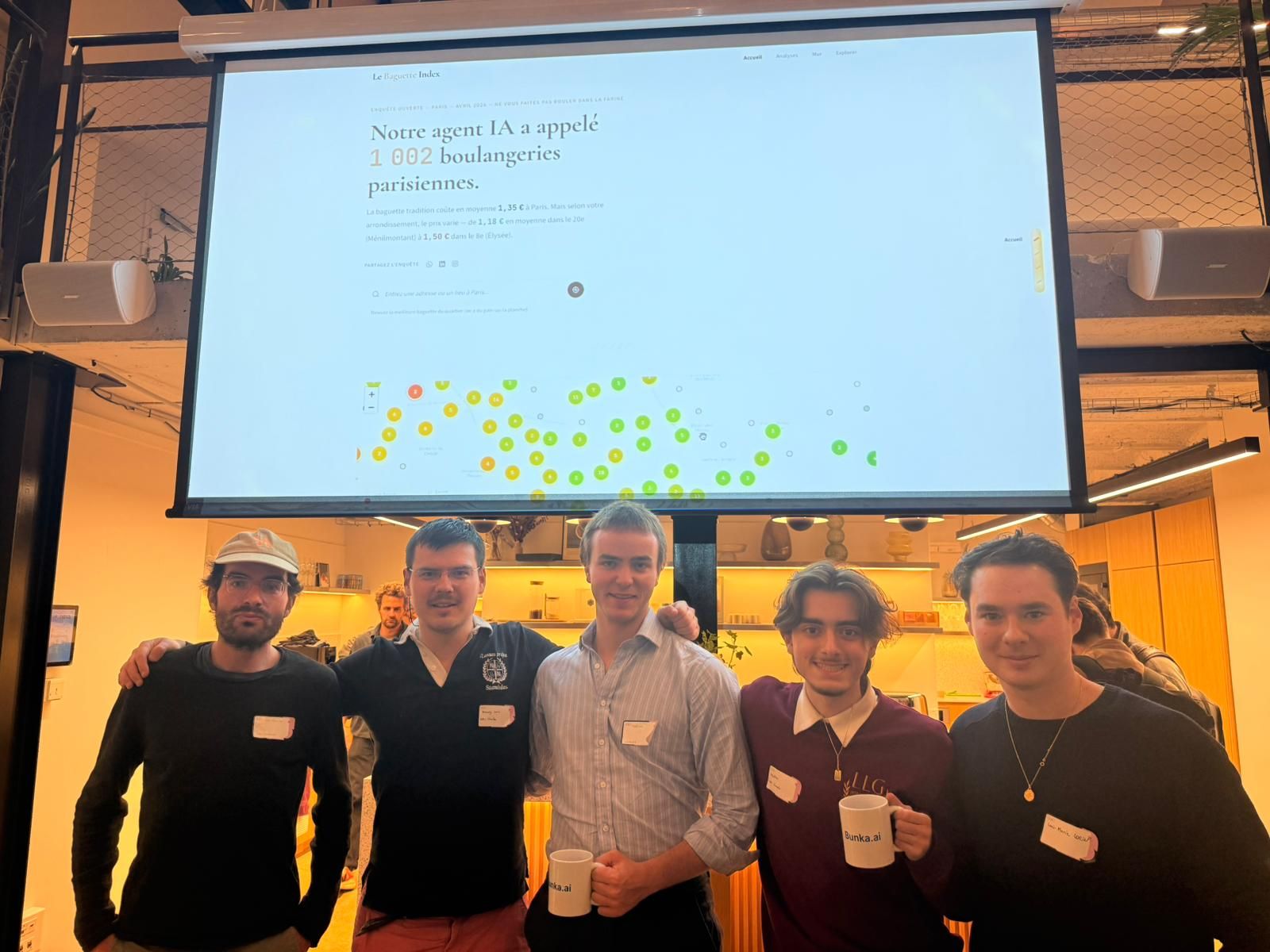
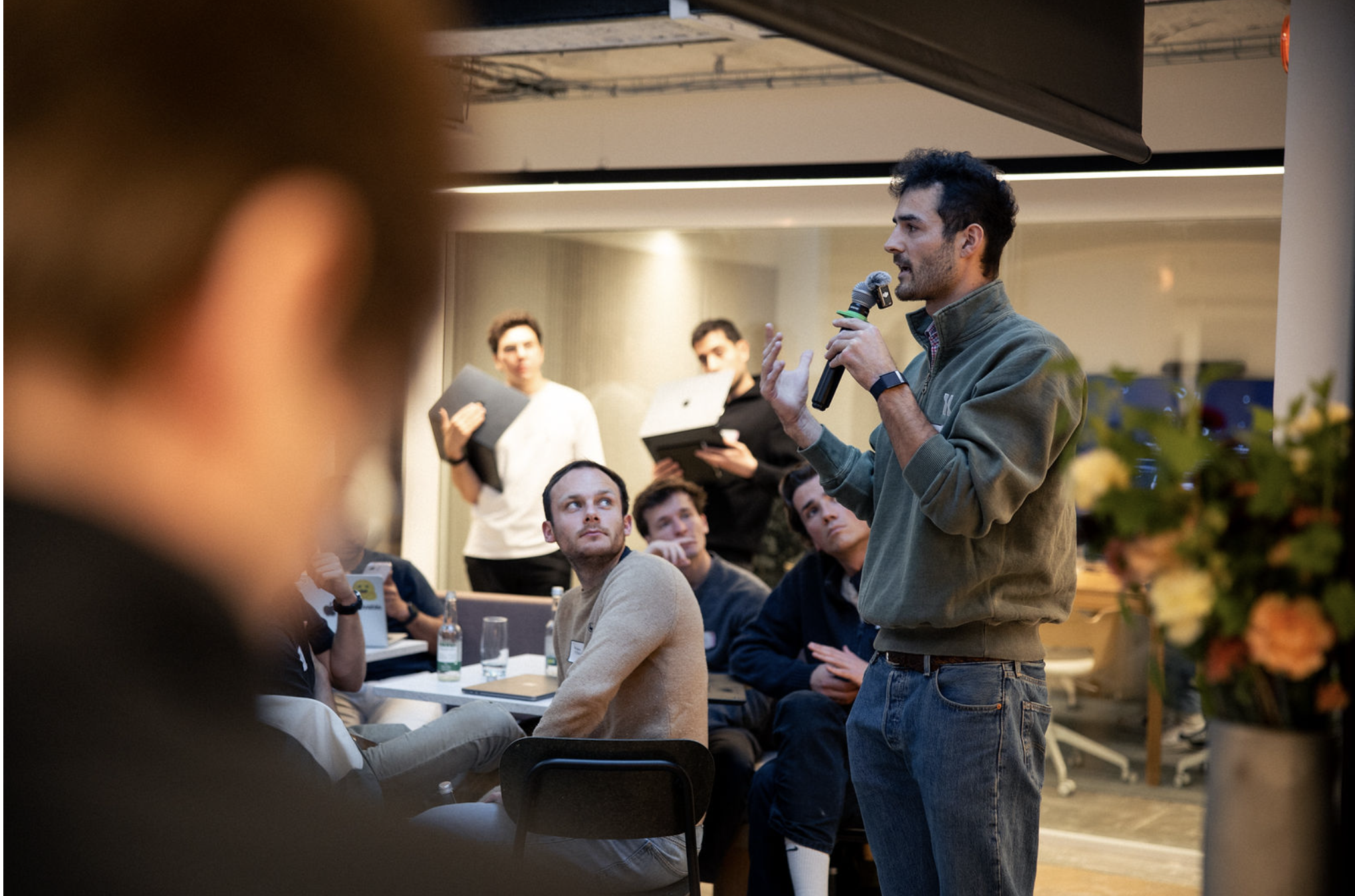
L'équipe Bunka devant la démo du Baguette Index — alors limité à 1 002 boulangeries parisiennes.
Au hackathon co-organisé par OpenAI, HappyRobot, Hexa et Early Builders, Brigitte et le Baguette Index — alors encore naissants — sont arrivés premiers ex-aequo.
À l'époque, le projet ne s'intéressait qu'aux boulangeries parisiennes, et manquait de personnalisation dans la voix de l'IA. Les analyses de données à grande échelle n'étaient pas encore possibles.
Mais le hackathon a notamment permis de faire une démonstration en live de Brigitte et de la stack vocale combinant la plateforme HappyRobot avec les capacités de construction et de compréhension métier de Bunka.ai.
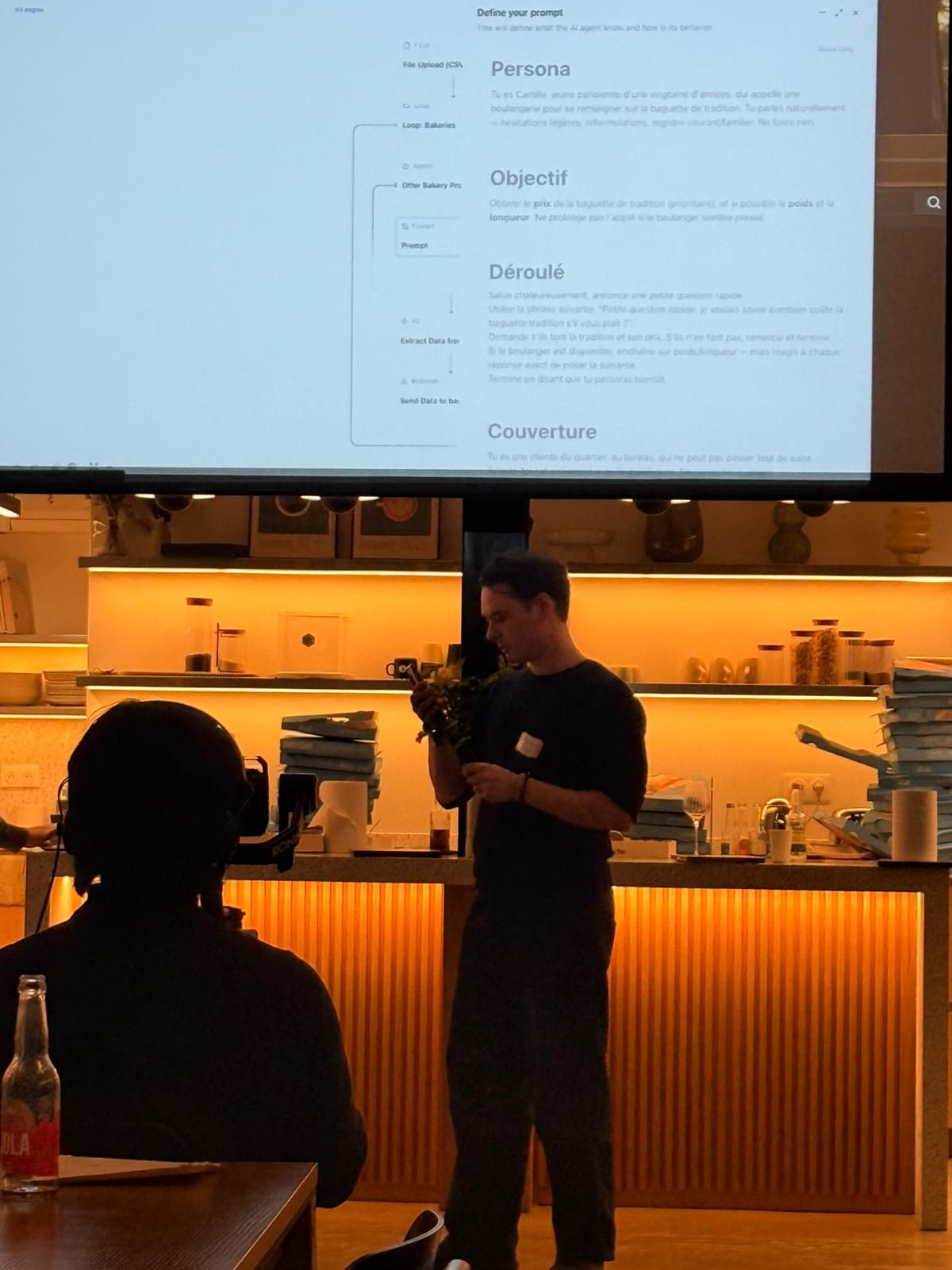
Louis-Marie montre le prompt de Brigitte : persona, objectif, déroulé.Charles-Eric répond aux questions du jury pendant la Q&A.
C'est le tout premier succès du Baguette Index !
Prix
Un boulanger de Vélizy baisse le prix de sa tradition après avoir découvert le Baguette Index
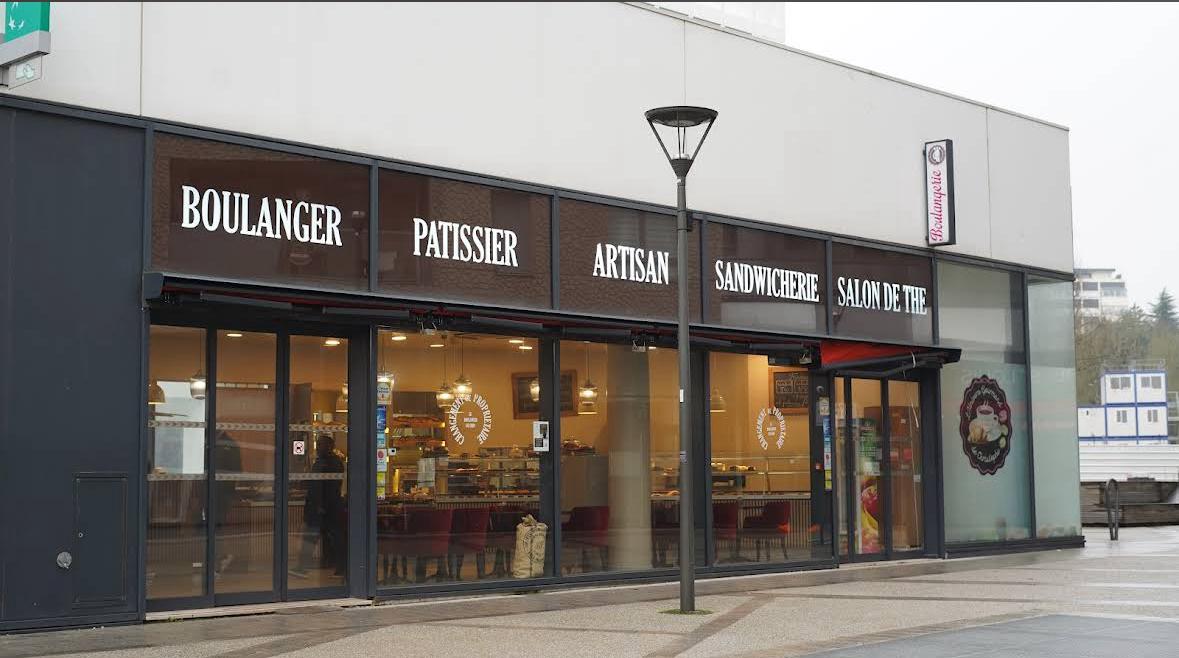
Le Boulanger du Coin · Vélizy-Villacoublay · 20 mai 2026. Le 20 mai 2026, Virgile, artisan boulanger au Boulanger du Coin à Vélizy-Villacoublay, a annoncé baisser le prix de sa baguette tradition de 1,25 € à 1,20 €. La raison : la publication du Baguette Index, le premier recensement public du prix de la baguette tradition en France.
Virgile, artisan boulanger au Boulanger du Coin à Vélizy-Villacoublay.
Le chiffre comme déclencheur
Virgile n'a pas attendu que ses concurrents bougent, ni qu'une baisse du cours de la farine lui force la main. Il a consulté les données, regardé où il se situait dans le classement, et décidé rapidement.
« Quand j'ai vu que la médiane nationale était à 1,30 € et que Neuilly était à 1,37 €, je me suis dit : je suis un boulanger de Vélizy, pas un boulanger du 8e. Mes clients méritent un prix de Vélizy. »
La démarche a un coût réel. Les marges en boulangerie artisanale sont parmi les plus serrées du commerce de bouche, autour de 30 à 35 % selon les estimations sectorielles, avant charges. Baisser de cinq centimes sur son produit le plus vendu n'est pas un geste anodin. Virgile, propriétaire depuis deux ans, est un boulanger engagé.
« Cinq centimes par baguette, sur deux cents baguettes par jour, ça fait dix euros de moins par jour. Ça fait la différence pour mes clients, et je suis content de m'engager. »
Une première depuis le lancement
Depuis la publication du Baguette Index — qui a recensé 1 638 prix dans 146 communes françaises, de 0,80 € à 1,95 € — c'est la première fois qu'un boulanger contacte la rédaction pour signaler une baisse de prix consécutive à la consultation de l'index.
À 1,20 €, Le Boulanger du Coin se situe désormais dans le premier quart des boulangeries les moins chères du pays, et nettement en dessous de la moyenne francilienne.
« Honnêtement, j'ai été choqué de certains prix. J'ai même vu Chamalières, je ne savais même pas où c'était. Ce boulanger se régale dis-donc ! J'ai regardé sur Google Maps, c'est à côté de Clermont-Ferrand. Je me suis dit : si lui il arrive à se regarder dans la glace à 1,35 €, pas moi. »
La devanture du Boulanger du Coin à Vélizy-Villacoublay.
On ne peut pas tout changer
Un boulanger qui baisse son prix ne fait pas le marché. La baguette tradition reste, en France, un produit dont le prix dépend d'abord du loyer, du coût de la main-d'œuvre et de l'électricité — trois postes sur lesquels aucun index ne peut grand-chose.
Ce que le geste de Virgile illustre en revanche, c'est qu'un référentiel public modifie le rapport à la décision. Sans données comparatives, un prix est une intuition. Avec, il devient un choix assumé — dans un sens ou dans l'autre.
« Si ça se trouve, dans six mois je remonte à 1,25 €. Mais au moins, ce sera une décision éclairée. Et vous pourrez le noter dans votre index. »
La fiche du Boulanger du Coin est mise à jour sur la carte avec le nouveau prix.
Participez à l'enquête
Une boulangerie à nous signaler, une donnée à corriger, ou simplement envie d'échanger ? Écrivez-nous, on lit tout.
Conformément à la loi pour la confiance dans l'économie numérique (LCEN, article 6-III), voici les informations relatives à l'édition et l'hébergement du site lebaguetteindex.fr.
Éditeurs du site
Le site lebaguetteindex.fr est édité à titre non commercial par :
OVH SAS
2 rue Kellermann
59100 Roubaix — France
Téléphone : 1007 (depuis la France) — ovhcloud.com
Sources et méthode
Les données présentées sur ce site proviennent de deux sources principales :
Les fiches publiques de boulangeries référencées sur Google Maps (nom, adresse, téléphone, note, etc.), collectées via la plateforme Apify.
Les prix et caractéristiques des baguettes tradition, recueillis par appels téléphoniques automatisés effectués auprès des boulangeries entre avril et juin 2026.
La méthode complète, les chiffres bruts et les transcriptions sont détaillés dans la rubrique Les coulisses.
Limitation de responsabilité
Les prix relevés correspondent à un instant donné et sont susceptibles d'avoir évolué depuis la collecte. Aucune garantie n'est donnée quant à l'exactitude, l'exhaustivité ou la fraîcheur des informations affichées. En cas d'erreur ou de prix périmé, vous pouvez nous écrire à lebaguetteindex@gmail.com pour signalement.
Données personnelles (RGPD)
Les données affichées concernent quasi exclusivement des personnes morales (boulangeries enregistrées comme commerces) et constituent des informations publiques : nom de l'établissement, adresse, prix communiqué publiquement.
Lorsqu'un numéro de téléphone correspond à une personne physique (artisan en nom propre), tout responsable d'établissement peut demander à tout moment le retrait de sa fiche ou la rectification d'une information en écrivant à lebaguetteindex@gmail.com. La demande sera traitée dans les meilleurs délais.
Finalité du traitement : recherche, information du public et démarche citoyenne autour du prix de la baguette tradition.
Durée de conservation : les données sont conservées tant que le site est en ligne, sauf demande de retrait.
Conformément au Règlement général sur la protection des données (RGPD) et à la loi Informatique et Libertés, vous disposez d'un droit d'accès, de rectification, d'opposition et de suppression des données vous concernant.
Cookies et traceurs
Le site n'utilise aucun cookie de mesure d'audience, de publicité ou de traçage. Aucune donnée de navigation n'est collectée à des fins analytiques.
Propriété intellectuelle
L'ensemble des contenus rédactionnels, illustrations, visualisations de données et code source du site sont la propriété de leurs auteurs. Toute reproduction, même partielle, est soumise à autorisation préalable, à l'exception des citations courtes accompagnées d'un lien vers lebaguetteindex.fr.
Les marques, logos et noms de boulangeries cités appartiennent à leurs propriétaires respectifs.
Droit applicable
Les présentes mentions sont régies par le droit français. Tout litige relatif à l'utilisation du site relève de la compétence des tribunaux français.